
Summary
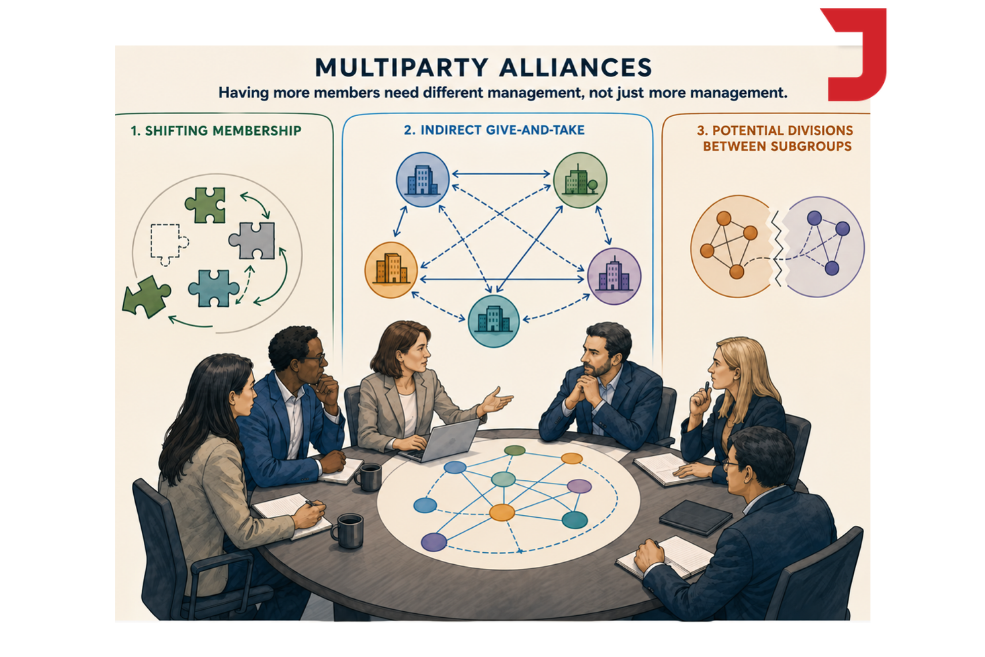
Adding partners to an alliance does more than add meetings: it changes the rules of collaboration. Our study reveals three distinctive dynamics to multiparty alliances—shifting membership, indirect give-and-take, and potential divisions between subgroups—that managers cannot tackle simply by scaling up two-partner practices. The key is understanding how partners depend on one another, then matching governance to those dependencies. Having more partners needs different management, not just more management.
More partners, different rules
The pitch sounds irresistible: bring several organizations together, combine their strengths, share the risks, and achieve something none could deliver alone. Then reality arrives. A founding partner leaves. One member appears to contribute little but still enjoys the benefits. A handful of long-standing collaborators start making decisions before everyone else enters the room. Suddenly, the challenge is not just delivering the project. It is keeping the partnership working.
These are multiparty alliances—collaborations involving three or more organizations under one collective agreement. They can bring together investors, researchers, manufacturers, or other partners pursuing shared strategic goals. But treating them merely as ordinary two-partner relationships with a longer invitation list overlooks important issues. Our research published in the Journal of Management Studies explains why that approach falls short to offer managers a more useful starting point.
Three ways the rules change
Beyond familiar challenges such as more complicated coordination, our systematic review of 173 research articles published in Financial Times 50 journals between 1990 and 2025 identified three dynamics that distinguish multiparty collaboration from dyadic ones.
Alliance members can change while the party continues. In a two-partner alliance, losing one partner ends that partnership. A multiparty alliance can survive departures and welcome newcomers. This creates flexibility, but also raises questions about admission, replacement, and the redistribution of responsibilities and influence.
“I help you, you help me” no longer tells the whole story. A partner may contribute expertise that benefits the entire alliance and receive value from someone other than the original recipient. This is generalized reciprocity: give-and-take that extends beyond direct exchanges. The difficulty is knowing whether everyone is pulling their weight, as well as whom to hold accountable when they are not.
Partners can split into camps. Prior relationships, shared interests, or differences in status can create faultlines—informal divisions between subgroups. Familiar collaborators may trust one another while excluding others. Decisions about what benefits the alliance can become battles over which subgroup wins.
Follow the work, not the label
The above dynamics do not affect every multiparty alliance equally. To understand where trouble is most likely, managers need to look beyond the alliance’s label. Calling a collaboration an “R&D consortium” or a “strategic partnership” tells surprisingly little about its daily management needs. The more revealing question is: How does each partner’s work depend on everyone else’s? Our research identifies three patterns.
In alliances with pooled interdependence, partners contribute relatively independently toward a shared outcome. Think of a collaboration in which members supply funds or separately deliver agreed work packages. Because contributions are relatively separable, membership changes are generally easier to accommodate. Replacing a contribution need not mean redesigning everyone’s work. Where inputs are clearly observable, under-contribution is also easier to spot. The managerial priority is therefore membership governance: Who can join? Who can leave? Who takes over an outstanding commitment? A practical implication is to establish clear entry and exit rules, make contributions visible, and plan how responsibilities will be reassigned.
With sequential interdependence, one partner’s output becomes another’s input. Work moves through a chain. Here, a missed handoff can become everyone’s problem. Replacing a specialist partner may require new investments, disrupted schedules, and changes to downstream activities. Subgroup tensions become especially dangerous when they interfere with critical transitions. The managerial priority shifts to protecting handoffs and bottlenecks. Clear delivery responsibilities, contingency arrangements, and attention to partner-specific investments deserve more emphasis than simply adding another alliance-wide meeting.
With reciprocal interdependence, partners continually adjust their work in response to one another. Imagine organizations jointly developing a technology through repeated experimentation and feedback. Contributions are harder to separate. Valuable know-how may reside in relationships and shared routines rather than in a measurable deliverable. This makes indirect give-and-take particularly challenging: everyone benefits from collaboration, but individual effort can be difficult to assess. Subgroup divisions can also undermine the communication and trust that joint problem-solving requires. Membership changes may be less frequent here precisely because replacement is so costly. Less turnover does not mean less damage when someone leaves. Managers should therefore pay particular attention to shared routines, meaningful discussions of contributions, and relationships across organizational boundaries.
Diagnose first, govern second
The practical message we advance is not that every multiparty alliance needs tighter contracts, more trust, or stronger central leadership. It is that different dependencies call for different management priorities.
For alliance managers, the priority is design of right governance. Rather than the number of partners or labels such as “R&D consortium”, decisions about governance should instead reflect partners’ dependencies. Where contributions are relatively independent, clear entry and exit rules and visible commitments deserve emphasis. Where work moves through a chain, delivery responsibilities and contingency arrangements become more important. Where partners continually adjust together, shared routines and discussions of contributions require greater attention.
For innovation managers, the priority is organizing interdependent work. Sequential activities require clear handoff responsibilities and contingency arrangements for bottlenecks. Reciprocal activities require shared routines for experimentation, feedback, and joint problem-solving. As projects move from separate work packages to joint development, coordination arrangements should evolve accordingly.
For senior managers deciding whether to establish or join an alliance, the priority is assessing the commitments and dependencies involved. Access to complementary capabilities may entail reliance on particular partners and substantial replacement costs. Participation decisions should therefore consider not only expected benefits, but also the organization’s capacity to sustain its commitments and respond to partner departures.
